The content and images in this curriculum and presentation are copyrighted and trademarked. Photographs’ subject matter is divided into categories. All photographs are by Zion Ozeri. You may only use the presentation or parts of it while implementing the DiverCity Lens in your school. For any other use, including reproduction, you must get special permission from Zion Ozeri. The use of the following content, which may be objectionable, is at your own risk, and Zion Ozeri holds no responsibility to evaluate the accuracy, completeness, and usefulness of any content provided, prior to your use. You may contact Zion Ozeri for any questions: zion@zionozeri.com
The Departure and Expulsion of the Jews from Muslim Countries
Lesson Plan | Grades 7–12 | by Zion Ozeri, Josh Feinberg, and Dara Unterberg
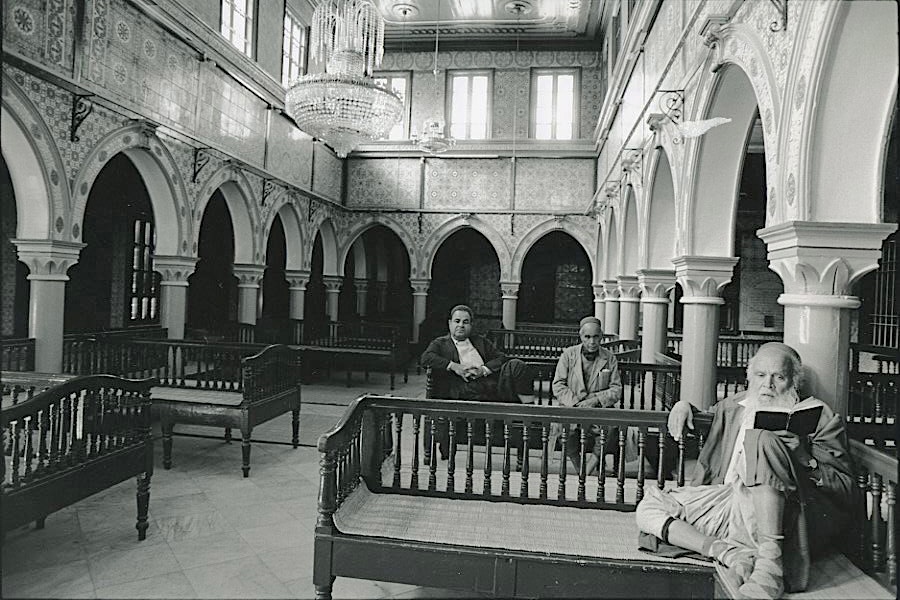
”Waiting for Seven Jews”, El Ghriba Synagogue, Djerba, Tunisia, 1995
All images © Zion Ozeri. All Rights Reserved.
Opening
Show the photograph from Djerba, Tunisia, without revealing its caption. Give students a moment to look closely, then ask: What do you notice about the people, the space, and the atmosphere of the photograph?
Part 1: Reading the Photograph
Continue discussing the photograph:
- What details in the photograph take on new meaning once you know its title?
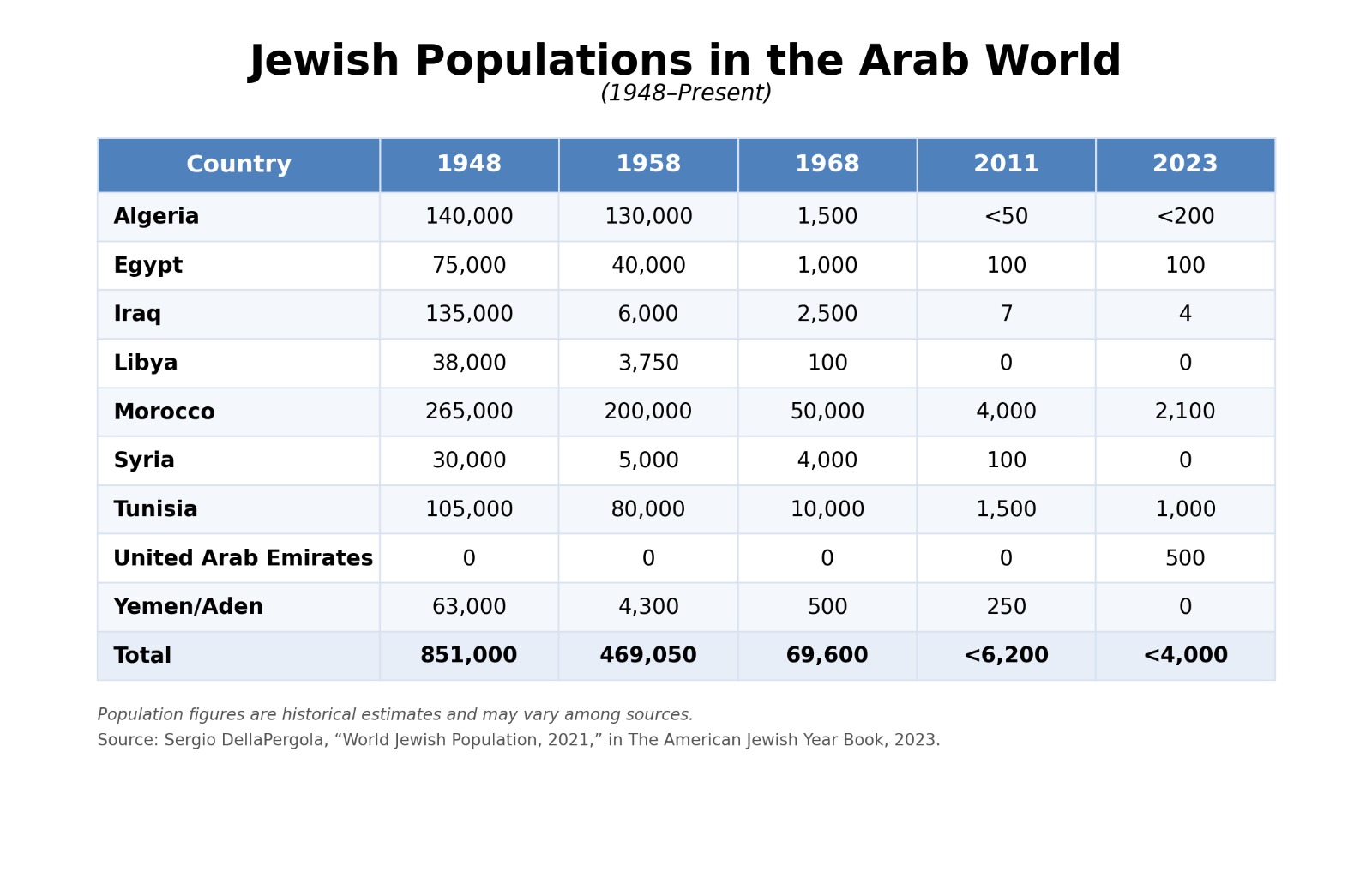
- Think back to the population numbers in the opening. How does this photograph give those numbers a human dimension?
- What might this photograph suggest about what happens to communal life when most members of a community leave?
- What does the photograph make you want to know about the Jewish community that once lived here?
Next, reveal the caption: “Waiting for Seven Jews,” El Ghriba Synagogue, Djerba, Tunisia, 1995.
Ask: What does the title add to your understanding of what you are seeing?
Note to educators:
The title “Waiting for Seven Jews” points to more than the difficulty of assembling a minyan. It captures the impact of demographic change on communal Jewish life: practices that depend on the presence of a community become difficult to sustain when that community becomes very small. The photograph was taken in Djerba in 1995, where a small Jewish community continues to live today.
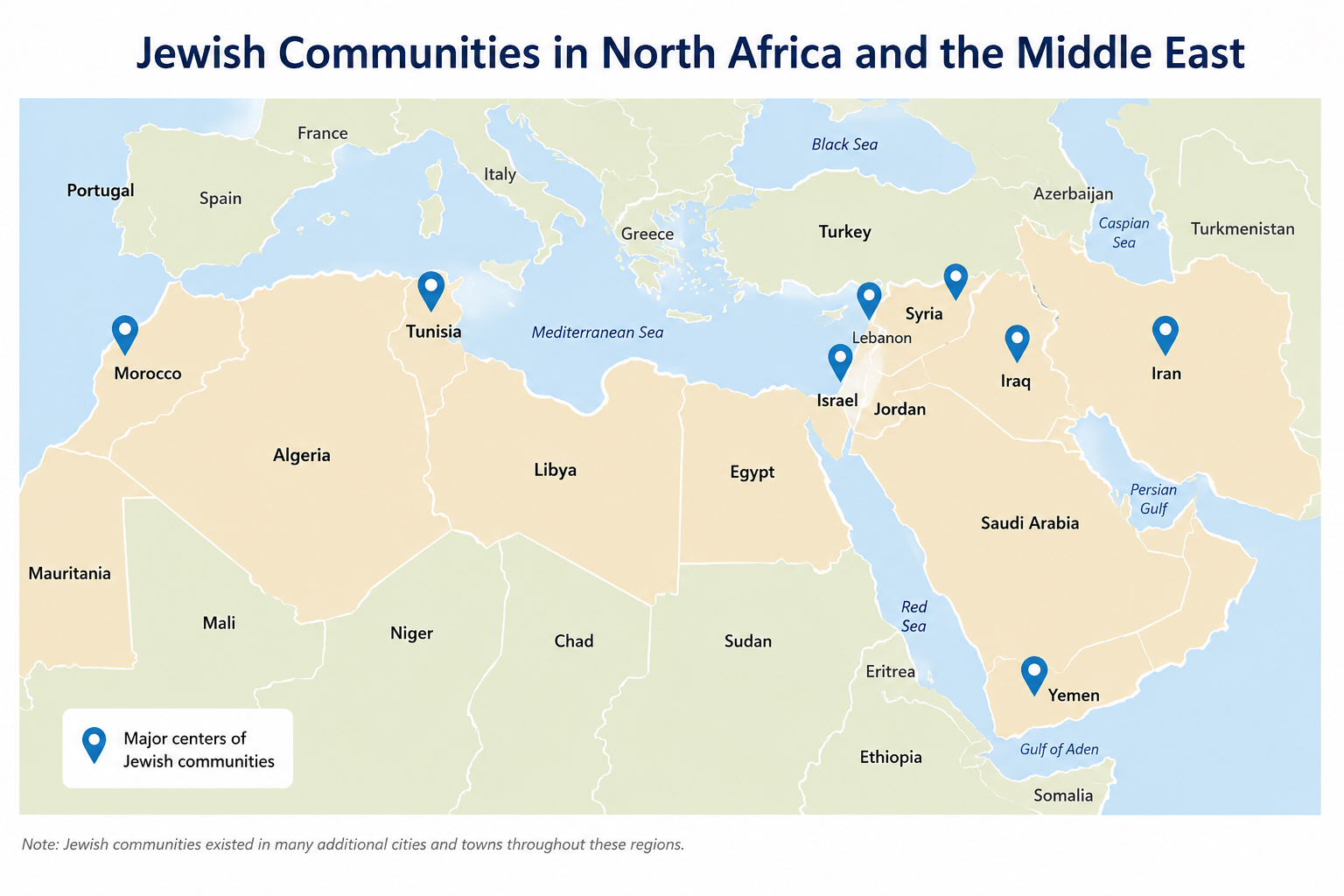
Display the map and briefly locate the Jewish communities across North Africa and the Middle East. Point out Morocco, Iraq, and Tunisia.
Now consider how in twenty years the vast majority of Jews left Muslim countries:
 Part 2: The Texts
Text 1: The Community in Djerba
According to local legend, Jews fleeing Jerusalem after the destruction of the First Temple brought a few Temple stones with them to Djerba. Despite several terrorist attacks in recent years, the synagogue continues to host an annual Jewish pilgrimage, drawing visitors from around the world.
The synagogue also reflects the world in which Djerban Jews lived. Its architecture, decoration, and some local Jewish customs show the influence of the surrounding Tunisian Muslim culture alongside distinctly Jewish traditions.
In the mid-twentieth century, Tunisia was home to more than 100,000 Jews. In the decades surrounding and following Tunisia’s independence from France in 1956, most left the country, primarily for France and Israel. By the end of the twentieth century, only a small Jewish population remained, concentrated largely on Djerba.
Sources: ANU – Museum of the Jewish People, “The Jewish Community of Djerba”; Center for Jewish Art, Hebrew University of Jerusalem, “El Ghriba Synagogue”; Smarthistory, “Architecture and Ritual in the Ghriba Synagogue, Tunisia.”
Text 2: Belonging and Insecurity
“Yes, indeed, we were Arab Jews—in our habits, our culture, our music, our menu… But must one remain an Arab Jew if, in return, one has to tremble for one’s life and the future of one’s children and always be denied a normal existence? The supposedly ideal life of the Jews in Arab lands is nothing but a myth!
…As far as the memories of my childhood go, in the stories of my father, my grandparents, my aunts and my uncle, living alongside the Arabs was not just uncomfortable, but it was filled with threats, which from time to time changed from the potential for violence to actuality. At the same time, one very significant fact should be remembered: during the colonial period [periods of European control of Muslim countries], the situation of the Jews was more secure, since it had a stronger legal basis.
…At no time—and I say this expressly: at no time—apart from two or three periods that involved unusual circumstances, and even then barely so—were the Jews who lived in Arab countries seen as anything other than persons of insignificant worth, open to dangers and subject to the occasional bouts of murder and killing, so that they should well remember their status.”
- Albert Memmi (Tunisian Jewish writer and philosopher, 1920–2020), introduction to Jews and Arabs
Discuss:
- What does the history of El Ghriba reveal about both the deep roots of Jewish life in Tunisia and its relationship with the surrounding culture?
- Memmi describes himself as an “Arab Jew” in his habits, culture, music, and food, while also describing fear and insecurity. How can both parts of his experience be true at the same time?
- How does Memmi’s testimony complicate a story of Jewish life in Muslim countries as either peaceful coexistence or constant persecution?
- Why do you think Jewish people continue to make pilgrimages to the El-Ghriba Synagogue?
Learn more:
El Ghriba Synagogue, Djerba, Tunisia | ANU Museum of the Jewish People | Open Databases
The expulsion of Jews from Arab countries and Iran | World Jewish Congress
A Brief History of Jews in Muslim Lands
Part 3: Synthesis
- Return to “Waiting for Seven Jews.” What do you see differently now that you know more about Djerba’s Jewish community and its history?
- What do the texts reveal about why so many Jews left that the population numbers and photograph alone cannot tell us?
- When most of a Jewish community leaves a place where Jews have lived for centuries, what is lost? What can remain?
Follow-up Activity
Oral History: Leaving Home
Interview and photograph a family member, neighbor, or acquaintance who moved from one country or community to another. If possible, choose someone whose family came from a Jewish community in North Africa or the Middle East.
Questions to Consider:
- What do you remember, or what have you been told, about the place you or your family came from?
- What did you or your family value or enjoy about life there?
- Why did you or your family leave? Was leaving a choice, a necessity, or a combination of both?
- What was it like to begin again somewhere new?
- What traditions, foods, language, music, or customs did you or your family bring with you?
- What connection do you still feel to the place you or your family came from?
Photography Prompt:
With permission, photograph the person with something that connects them to their family’s past, such as a photograph, object, food, book, or religious item. Add a short caption sharing one detail or memory from the interview that you would want others to remember.