The content and images in this curriculum and presentation are copyrighted and trademarked. Photographs’ subject matter is divided into categories. All photographs are by Zion Ozeri. You may only use the presentation or parts of it while implementing the DiverCity Lens in your school. For any other use, including reproduction, you must get special permission from Zion Ozeri. The use of the following content, which may be objectionable, is at your own risk, and Zion Ozeri holds no responsibility to evaluate the accuracy, completeness, and usefulness of any content provided, prior to your use. You may contact Zion Ozeri for any questions: zion@zionozeri.com
Revelation at Sinai
Lesson Plan | Grades 7–12 | by Zion Ozeri and Josh Feinberg
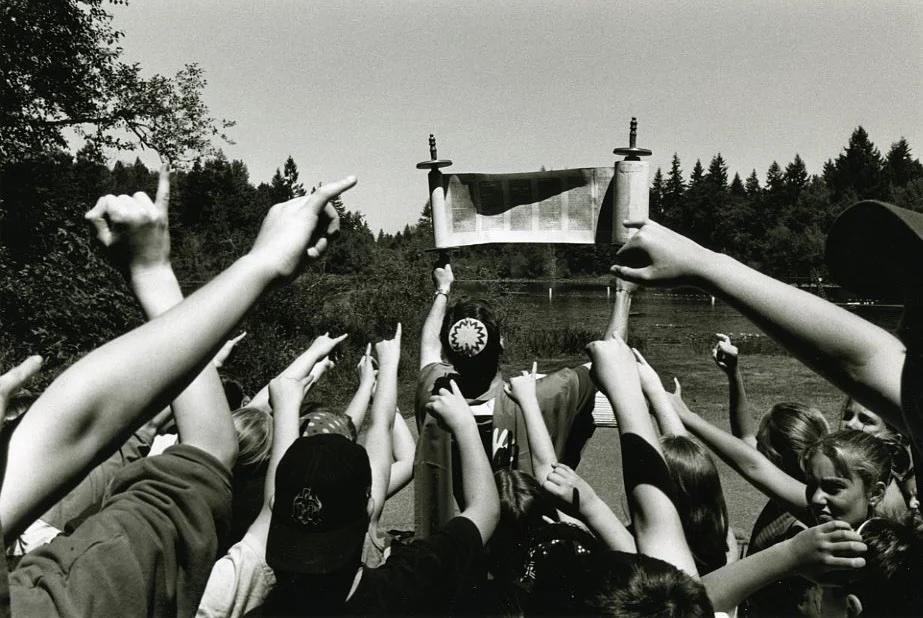
Summer Camp, Washington State, USA, 20024
All images © Zion Ozeri. All Rights Reserved.
Opening
Before showing the photograph, ask students:
"Imagine you're about to be handed a set of rules that you'll be expected to follow for the rest of your life — and everyone around you is reaching toward it, pointing at it, straining to touch it. What would it take for you to actually want that? What would make you reach for it too, instead of stepping back?"
Take a few quick answers, then reveal the photograph.
Part 1: Reading the Photograph
Look closely at this photograph and discuss:
- What do you think is happening in this picture?
- Notice the gesture the kids are making toward the Torah. How do you interpret this gesture? What does it suggest or signify to you?
- Where is the photographer positioned in relation to the Torah and the kids? Why do you think Zion Ozeri chose this specific vantage point? What effect does it create for the viewer?
- This photograph was taken at a summer camp — not a synagogue. How does that physical setting affect the impact or message of the photograph?
- What does this photograph suggest to you about the relationship between people and the Torah? Does it reflect anything about your own relationship to it? How so?
Part 2: The Text

Exodus 19:18-20
Now Mount Sinai was all in smoke, for GOD had come down upon it in fire; the smoke rose like the smoke of a kiln, and the whole mountain trembled violently. The blare of the horn grew louder and louder. As Moses spoke, God answered him in thunder. GOD came down upon Mount Sinai, on the top of the mountain, and GOD called Moses to the top of the mountain and Moses went up.
God giving the Ten Commandments to Moses on Mount Sinai is described as a moment that was powerful, even a little terrifying. There was thunder, lightning and smoke, and then Moses came down from the mountain with the tablets. Here's what the Torah says happened shortly after the commandments were given:

Exodus 24:7
Then he (Moses) took the record of the covenant and read it aloud to the people. And they said, All that GOD has spoken we will faithfully do!
Discuss:
- Why do you think that there’s such a dramatic scene surrounding the giving of the ten commandments at Mount Sinai? Why so much noise and light?
- Why do you think the people of Israel agree to “faithfully” obey all the laws that they were given?
- The laws are described as a “covenant,” because they represent an agreement between God and the people about how the people will behave. What rules or laws have you agreed to follow in your life, and why?
- Which of the ten commandments can you list? Which ones do you think have the most impact on Jewish life today?
- If you were to create a list of the “top ten rules” of Judaism, what would be on your list, and why?
Part 3: Synthesis
Revisit the photograph and the text side by side.
- How does this text relate to the photograph?
- How is the photograph different from the scene painted by the text in terms of action, mood, and setting? How are they similar, despite those differences?
- Do you think our relationship with the Torah has changed since biblical times? What's different? What has stayed the same?
- Do you think the way we relate to the Torah physically (reaching towards it, holding it,
etc) can influence the way we think or feel about it? Why or why not?
Follow-Up Activities
1. Your Top Ten Rules of Judaism
Create your own list of the top ten rules of Judaism. Share your list in small groups. How are your lists similar or different from each other? How do they differ from the Ten Commandments in the Torah? Where do you think those differences come from?
2. Illustrate a Rule
Choose one of your top ten rules to illustrate in a photograph; candid, posed, or staged. Think carefully about how you want to communicate the rule: by showing someone faithfully following it, or by representing what happens when it's ignored. Find a quote from the Torah to accompany and support your photograph
3. Torn-Paper Collage: The Moment of Revelation
Using only colored construction paper and glue, no markers, or scissors, create a torn-paper collage capturing the events and emotions of the biblical account at Sinai, as you perceive them. Share your work with the class.
For Further Research
Mount Sinai - Jewish Virtual Library
The Ten Commandments - Jewish Education By Design
At Mount Sinai - Jewish Education By Design