The content and images in this curriculum and presentation are copyrighted and trademarked. Photographs’ subject matter is divided into categories. All photographs are by Zion Ozeri. You may only use the presentation or parts of it while implementing the DiverCity Lens in your school. For any other use, including reproduction, you must get special permission from Zion Ozeri. The use of the following content, which may be objectionable, is at your own risk, and Zion Ozeri holds no responsibility to evaluate the accuracy, completeness, and usefulness of any content provided, prior to your use. You may contact Zion Ozeri for any questions: zion@zionozeri.com
Status of Jews and Minorities Under Islam
Lesson Plan | Grades 7–12 | by Zion Ozeri and Josh Feinberg
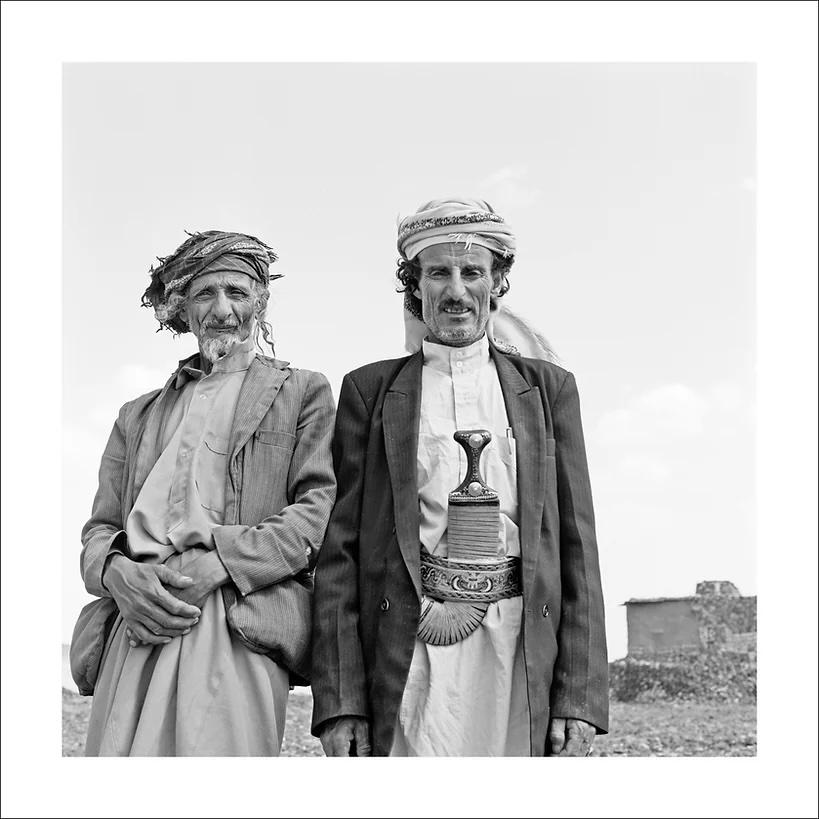
Status Symbol, Al Haife, Yemen, 1993
All images © Zion Ozeri. All Rights Reserved.
Opening
Project the photograph without giving students its title, location, date, or any information about the two men. Give them 60 seconds to look closely in silence.
Ask: Imagine you had to describe these two men to someone who could not see the photograph. What would you say first?
Take several responses, recording key observations on the board.
Part 1: Reading the Photograph
Look closely at this photograph and discuss:
- What details might you have missed when you first looked at the photograph?
- What can you infer about the lives or identities of these two men from what you see based on evidence in the photograph?
- Who appears to have greater status or authority in this photograph, if either man does? What makes you think so?
- The photographer, Zion Ozeri, titled this photograph Status Symbol. What do you think the title refers to?
- Now that you know the title, does it change anything about the way you understand the photograph? Why?
- The photographer, Zion Ozeri, calls this photograph “Status Symbol.” How does that influence your reading of the photograph?
This photograph was taken in Al Haife, Yemen, in 1993. The photographer explains that the man on the right is Muslim and the man on the left is Jewish. Only the man on the right wears a curved dagger called a shabriah — a status symbol that only Muslim men were allowed to carry in this society. Another difference: the Jewish man has peot, or sidelocks. Many religious Jewish men choose to wear peot, but in Yemen, all Jewish men were required by the local Islamic regime to wear them as a sign of their difference, unless they converted to Islam. Yemenite Jews called it simanim — Hebrew for "signs." There is no Jewish community left in Yemen; nearly all remaining Yemenite Jews have immigrated to Israel.
Part 2: The Text
Text 1: Deuteronomy Chapter 13
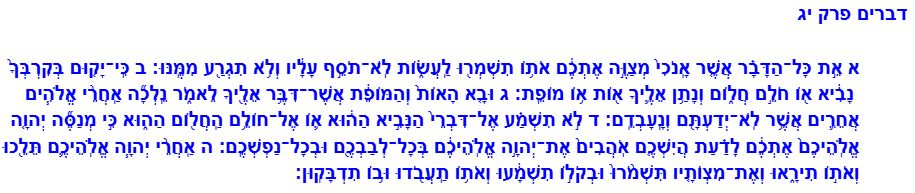
Now read this text from Deuteronomy, which commands the Israelites to remain faithful to their God despite pressure to do otherwise:
Deuteronomy 13:1-5
Be careful to observe only that which I enjoin upon you: neither add to it nor take away from it. If there appears among you a prophet or a dream-diviner, who gives you a sign or a portent, saying, Let us follow and worship another godwhom you have not experiencedeven if the sign or portent named to you comes true, do not heed the words of that prophet or that dream-diviner. For the ETERNAL your God is testing you to see whether you really love the ETERNAL your God with all your heart and soul. The ETERNAL your God is the One whom you should follow, whom you should revere, whose commandments you should observe, whose orders you should heed, whom you should worship, and to whom you should hold fast.
Discuss:
- What does this text command Jews to do? What does it command Jews not to do?
- How have the ideas in this text been applied in different contexts throughout Jewish history?
- How do the ideas in this text apply to your life today?
- What, if anything, would push you to disobey this commandment? What if following Judaism meant being treated as a second-class citizen, or having fewer rights? How would you respond?
In the 7th century, Muslim rule spread across most of the Middle East. Under Muslim rule, non-Muslims were typically subjected to certain restrictions. There were Jews living throughout the Muslim world at the time. While the severity of the restrictions ebbed and flowed over time and from place to place, many restrictions remained in place even into modern times.
Text 2: The Pact of Umar
After the rapid expansion of Muslim rule in the 7th century, Muslim leaders were required to work out a way of dealing with non-Muslims, who remained the majority in many areas for centuries. The solution was recorded in the Pact of Umar, which is said to be the peace accord offered by the Caliph Umar to the Christians of Syria, a pact that set the precedent for later Muslim–non-Muslim relations. It outlines the privileges and restrictions non Muslims, called Dhimmi, were subject to. The rules outlined here applied to Jews as well as Christians. While the severity of the restrictions ebbed and flowed over time and from place to place, many restrictions remained in place even into modern times.
The Pact of Umar
We heard from 'Abd al-Rahman ibn Ghanam as follows:
When Umar ibn al-Khattab, may God be pleased with him, accorded a peace to the Christians of Syria, we wrote to him as follows:
In the name of God, the Merciful and Compassionate. This is a letter to the servant of God Umar [ibn al-Khattab], Commander of the Faithful, from the Christians of such-and-such a city. When you came against us, we asked you for safe-conduct (aman) for ourselves, our descendants, our property, and the people of our community, and we undertook the following obligations toward you:
- We shall not build, in our cities or in their neighborhood, new monasteries, Churches, convents, or monks' cells, nor shall we repair, by day or by night, such of them as fall in ruins or are situated in the quarters of the Muslims.
- We shall keep our gates wide open for passersby and travelers. We shall give board and lodging to all Muslims who pass our way for three days.
- We shall not give shelter in our churches or in our dwellings to any spy, nor bide him from the Muslims.
- We shall not teach the Qur'an to our children.
- We shall not manifest our religion publicly nor convert anyone to it. We shall not prevent any of our kin from entering Islam if they wish it.
- We shall show respect toward the Muslims, and we shall rise from our seats when they wish to sit.
- We shall not seek to resemble the Muslims by imitating any of their garments, the qalansuwa, the turban, footwear, or the parting of the hair. We shall not speak as they do, nor shall we adopt their kunyas.
- We shall not mount on saddles, nor shall we gird swords nor bear any kind of arms nor carry them on our persons.
- We shall not engrave Arabic inscriptions on our seals.
- We shall not sell fermented drinks.
- We shall clip the fronts of our heads.
- We shall always dress in the same way wherever we may be, and we shall bind the zunar round our waists.
- We shall not display our crosses or our books in the roads or markets of the Muslims. We shall use only clappers in our churches very softly. We shall not raise our voices when following our dead. We shall not show lights on any of the roads of the Muslims or in their markets. We shall not bury our dead near the Muslims.
- We shall not take slaves who have been allotted to Muslims.
- We shall not build houses overtopping the houses of the Muslims.
The Pact of Umar - Medieval Sourcebook, Fordham University
Discuss:
- What do you notice about these restrictions?
- Which ones seem more harsh to you? Which do you think would be the hardest to follow?
- Are any puzzling to you? Which ones and why?
- How do you think it would feel to have to follow these rules?
- Have you heard or learned about any similar rules around the world historically or today?
For Further Research
The Pact of Umar Regulating the Status of Non-Muslims Under Muslim Rule - Jewish Virtual Library
The Treatment of Jews in Arab/Islamic Countries - Jewish Virtual Library
From Golden to Grim: Jewish Life in Muslim Spain - My Jewish Learning
Jews in the Islamic World | PBS LearningMedia
Part 3: Synthesis
- Both Jewish law and outside authorities have placed demands on how Jews live and identify themselves. What is the difference between obligations that come from your own tradition and restrictions imposed by the society around you? How might each shape a person’s sense of identity?
- The Deuteronomy text describes God “testing” the people's loyalty. Do you think centuries of living under restrictions like the Pact of Umar functioned as a kind of test for the Jewish communities who lived under them? What do you think that test revealed?
- A photograph, a legal text, and a book of commandments are three very different kinds of evidence. What does each one tell us about what it meant to be a religious minority under Muslim rule that the others cannot?
Follow-Up Activities
1. The Double Portrait
Photograph a portrait of two people. Consider how you will show their relationship. How will their pose, setting, clothing, and props help tell a story about these two people and the connection between them?
2. Trace a Community
Research the history of a Jewish community that lived in a Muslim nation. How long had the community been there? What was unique or distinctive about it? How were its members treated over time? What was their life like? What eventually happened to the community? Where are its descendants today?