The content and images in this curriculum and presentation are copyrighted and trademarked. Photographs’ subject matter is divided into categories. All photographs are by Zion Ozeri. You may only use the presentation or parts of it while implementing the DiverCity Lens in your school. For any other use, including reproduction, you must get special permission from Zion Ozeri. The use of the following content, which may be objectionable, is at your own risk, and Zion Ozeri holds no responsibility to evaluate the accuracy, completeness, and usefulness of any content provided, prior to your use. You may contact Zion Ozeri for any questions: zion@zionozeri.com
Zionism, Herzl, and the First Zionist Congress
Lesson Plan | Grades 7–12 | by Zion Ozeri and Josh Feinberg

In Basel I Established the Jewish State, Tel-Aviv, 2015
All images © Zion Ozeri. All Rights Reserved.
Opening
What is happening in this photograph that makes it worth taking?
Give students a moment to think before opening the question to the room. As they respond, press them to point to specific details in the photograph that support their ideas.
Do not provide any information about the location or the quotation yet. Let the question remain open as students move into Part One.
Part 1: Reading the Photograph
The story behind the photograph:
Zion Ozeri took this photograph of a ramp leading down to a parking garage in a busy Tel Aviv neighborhood called Basel Square. The garage owner had printed a quote on the side of the ramp by early Zionist leader Theodor Herzl: “In Basel, I Established the Jewish State.” Basel, Switzerland, was the site of an important meeting of Zionist leaders in 1897, known as the First Zionist Congress.
Discuss:
- Why do you think the garage owner chose to put this quote here?
- Does anything surprise you about the quote or its placement?
- How does it change your understanding of the photograph to know where it was taken and what the quote says?
Part 2: The Texts
Text 1: Theodor Herzl, diary entry, 1897
Below is more of the quotation painted on the parking garage wall — the fuller passage from Herzl's diary, written the night the First Zionist Congress ended in Basel.
"Were I to sum up the Basel Congress in a word, which I shall guard against pronouncing publicly, it would be this: At Basel, I founded the Jewish State. If I said this out loud today, I would be answered by universal laughter. Perhaps in five years, certainly in fifty, everyone will know it."
Discuss:
- Why do you think Herzl wanted to “guard against pronouncing publicly” this statement?
- Why do you think he believed that everyone would know it in 50 years?
- How do you think Herzl would react if he saw this photograph?
Text 2: More Words from Herzl
Read these additional quotes by Herzl:
"No human being is wealthy or powerful enough to transplant a nation from one habitation to another. An idea alone can achieve that and this idea of a State may have the requisite power to do so. The Jews have dreamt this kingly dream all through the long nights of their history. "Next year in Jerusalem" is our old phrase. It is now a question of showing that the dream can be converted into a living reality." - 1896
"If you will it, it is not a dream." - 1902
"I once called Zionism an infinite ideal, and I truly believe that even after we achieve our land, the land of Israel, it will not cease to be an ideal. Zionism, as I see it, entails not only an aspiration for a piece of land legally ours, but also for moral and spiritual integrity." circa 1902
Discuss:
- What do you think Herzl meant when he said “If you will it, it is not a dream”?
- How did Herzl understand the relationship between dreaming about the Jewish state and making it a reality? What does it take to turn a dream into reality?
- Israel was a dream for generations of Jews, but for your generation it has always existed. How might that affect the way you think about it?
- Herzl refers to the words said each year at the end of the Passover Seder: “Next year in Jerusalem.” What do these words mean to you today?
For further research:
First Zionist Congress & Basel Program
The Zionist Congress - The National Library of Israel
Theodor Herzl (1860-1904) - The Herzl Institute
Theodor Herzl - The National Library of Israel
Text 3: Psalms 137:5–6
The book of Psalms, traditionally attributed to King David, describes a similar feeling of deep longing for the city of Jerusalem.
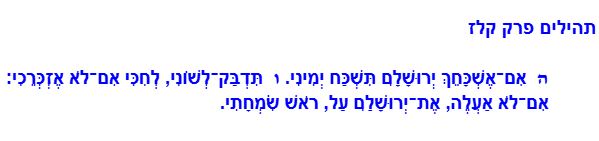
Psalms 137:5-6
If I forget thee, O Jerusalem, Let my right hand forget her cunning. Let my tongue cleave to the roof of my mouth, If I remember thee not; If I set not Jerusalem Above my chiefest joy.
Discuss:
- Why do you think the poet uses the image of a hand losing its ability to work if Jerusalem is forgotten?
- What might it mean to set Jerusalem above your highest joy?
- Does the feeling of missing something or someone so much that it interferes with your happiness resonate with you? Can you think of other examples, from your own life or from history?
- For millennia, Jewish grooms have recited this verse before breaking a glass at their wedding. Why do you think that is?
Part 3: Synthesis
- Keep the photograph, Herzl's words, and the verse from Psalms in mind. This verse is nearly three thousand years old — written long before Herzl, long before the First Zionist Congress — and yet it describes the same yearning. What does it mean that a modern political dream and an ancient poem are, in some sense, saying the same thing?
- Herzl said, “if you will it, it is not a dream,” but the Psalm suggests Jerusalem was never forgotten to begin with — it was held onto for thousands of years without a state at all. Which do you think mattered more to Zionism's success: an act of will, or an unbroken memory?
- A parking garage, a diary entry, and an ancient poem are three very different kinds of evidence for the same idea. What does each one prove that the others cannot?
Follow-Up Activities
1. Text and Image
Take a photograph that makes a statement by combining images and text in the same frame. How does the text reinforce the imagery? How does the imagery support the text?
2. A Plan for Your Dream
Consider a dream you have. Think about the actions you'll need to take to actually achieve it. Write a step-by-step action plan for realizing your dream.