The content and images in this curriculum and presentation are copyrighted and trademarked. Photographs’ subject matter is divided into categories. All photographs are by Zion Ozeri. You may only use the presentation or parts of it while implementing the Picturing Israel in your school. For any other use, including reproduction, you must get special permission from Zion Ozeri. The use of the following content, which may be objectionable, is at your own risk, and Zion Ozeri holds no responsibility to evaluate the accuracy, completeness, and usefulness of any content provided, prior to your use. You may contact Zion Ozeri for any questions: zion@zionozeri.com
Lech L'cha - Starting the Journey
Lesson Plan | Grades 7–12 | by Zion Ozeri and Josh Feinberg
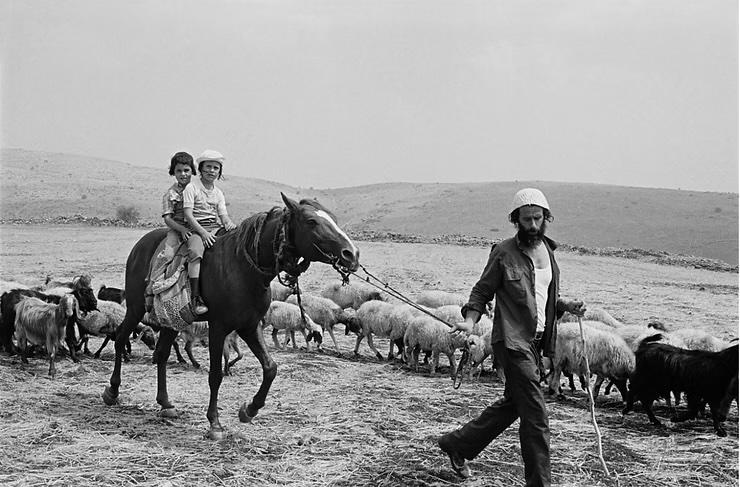
Shepherd, Kfar Zetim, Israel, 1984
All images © Zion Ozeri. All Rights Reserved.
Opening: First Look
Before any discussion, project the photograph and give students 60 seconds of silence to simply look — no talking, no analysis yet.
"Say one word — just one — that this photograph makes you think of. No explanation yet."
Go around the room quickly, collecting single words on the board. This builds a shared visual vocabulary before deeper analysis begins, and creates a record you can return to at the end of the lesson.
Part 1: Reading the Photograph
Look closely at the image and discuss:
- What do you see? Who are the subjects, and how would you describe the setting?
- This photograph freezes a single moment, yet it feels like it's mid-motion. What visual choices — composition, gesture, gaze — create that sense of movement in a still image?
- The shepherd is looking down. What does his expression communicate? What do you imagine he's thinking in this moment?
- Consider the two children on the horse, and the shepherd walking ahead. What does the physical arrangement of the figures — who leads, who follows, who is elevated, who is grounded — tell us about roles and relationships within this scene?
- A shepherd's job requires equal parts vigilance and trust. What visual evidence in this photograph suggests responsibility? What suggests trust?
- Why does a flock follow a shepherd, rather than needing to be forced or driven? What does that require of the shepherd, and what does it require of the flock?
- Zion Ozeri took this photograph in 1984. What do you imagine has changed about this scene since then — and what do you think hasn't?
Part 2: The Text
Read the following text from Genesis — the first time God speaks directly to Abram.

Genesis 12:1-2
God said to Abram, Go forth from your native land and from your fathers house to the land that I will show you. I will make of you a great nation, And I will bless you; I will make your name great, And you shall be a blessing.
Bridge question, before discussion:
Keep the photograph in mind. In this text, someone is told to leave everything familiar and lead his family toward a destination he cannot see. What connections do you notice between this call and the image we just examined?
Discuss:
- What do you think makes a journey worthwhile — is it the destination, the uncertainty itself, or something else?
- God doesn't tell Abram where he's going, only that he must go. Why do you think the text withholds that information? What effect does that have on the reader — and what might it have had on Abram?
- Why might Abram have been unable to fulfill his purpose while remaining in his birthplace? What does leaving require of a person that staying does not?
- Compare two phrases in the text: "I will bless you" and "you shall be a blessing." What's the difference between receiving a blessing and becoming one? Which do you think is the harder calling?
- The Jewish story doesn't begin with a nation, a land, or an institution — it begins with one person walking into the unknown. Why might that origin point matter? What does it suggest about how the tradition understands leadership, faith, or identity?
- Return to the photograph. Is anyone in this narrative functioning as a "shepherd" — leading others who must trust him without full information? Defend your answer using specific details from the text.
- Have you ever made a decision — large or small — without knowing how it would turn out? What did that experience require of you, and how did it compare to what's being asked of Abram?
Part 3: Synthesis
- A shepherd leads a flock that has no choice but to trust him. Abram leads his household into a future he cannot see, on the strength of a voice he trusts. What is the relationship between leadership and faith in both cases? Can you have one without the other?
- Photography and text are two different "languages" for telling a story. What can a photograph capture that text cannot? What can text convey that a photograph cannot?
- If you were to photograph this text — Genesis 12:1–2 — right now, in a completely different setting than ancient Israel, what would that image look like? Who would be in it?
Follow-Up Activities
1. Photographic Portrait: "Someone Who Leads the Way"
Photograph a person in your life who embodies the qualities of a shepherd — someone others trust to lead them somewhere uncertain (a coach, a parent, a mentor, a rabbi, a teacher). Write a paragraph explaining your choice, using specific visual details from your photograph as evidence, the way we did with Zion Ozeri's image.
2. Personal Narrative: "Lech L'cha" — A Journey Into the Unknown
Write a short narrative — true or fictional — about a journey undertaken without knowing exactly where it would lead. Take or select photographs to illustrate key moments. Consider: where does the "shepherd" or guiding voice appear in your story, if at all?
3. Photo-Text Pairing (extension for advanced students)
Choose any photograph — your own or a found image — and pair it with a text (biblical, historical, or contemporary) that it seems to be in conversation with, the way this lesson paired Ozeri's photograph with Genesis. Write a short analysis of what the pairing reveals that neither the image nor the text fully conveys alone.
Closing Reflection
Return to the photograph one final time.
If someone you trusted said to you, 'Come, follow me — I can't tell you exactly where we're going, but I promise it will make you into who you're meant to be' — would you go? What would you need to know first? What would you be willing to leave behind?
Revisit the single words the class offered at the start of class. Ask: has your word changed? Would you choose a different one now?
For Further Research
Taking the Journey with Abraham - Jewish Theological Seminary
Abraham - Jewish Virtual Library
Shepherd Consciousness | My Jewish Learning